

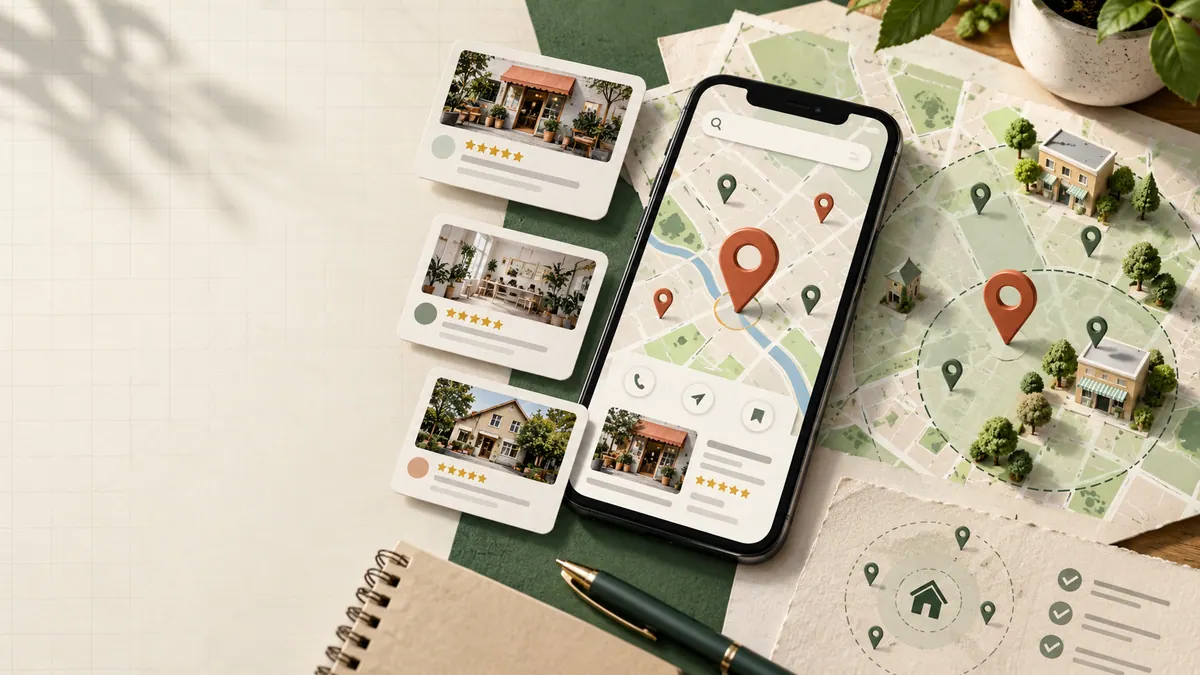
“Proudly serving the entire surrounding region” sounds friendly, but it doesn’t tell a customer whether you’ll actually come to their property.
For service businesses, the operating area is part of the offer. It affects availability, travel costs, response times and whether someone should bother filling out a form.
A good service-area explanation answers those questions without turning the page into a list of every town within driving distance.
Start with where the team actually works
Before editing the website, write down the places you regularly serve.
Separate your core service area from locations you take on only for larger jobs or special circumstances. If the business has different travel policies for emergency and planned work, record that too.
Don’t claim statewide coverage because a map looks better that way. Clear boundaries save time for your team and customers.
Say what changes by location
Some companies can offer exactly the same service across their entire area. Others have different appointment availability, minimum job sizes or travel fees.
Those differences matter more than repeating the town name.
For example, a contractor could explain that routine repairs are normally booked within its core area, while larger installations outside it are assessed individually. That’s illustrative wording, not a policy to copy unless it’s true.
The best service-area description reflects real operations.
Put the information where customers need it
A short overview on the homepage helps visitors recognize the geographic fit. Detailed service pages can clarify whether each offering is available in the same area.
The contact form can also ask for a town or postcode when it helps the team evaluate the enquiry.
Don’t hide all of this in tiny footer text. A visitor considering a quote should know whether travel or availability could affect the decision.
Our mobile quote form guide explains how to ask for location information without making the form unnecessarily long.
Use real local context
If a location has specific service requirements, a local page may be valuable.
For example, a contractor might explain genuine access restrictions, weather-related preparation, typical service availability or a documented local project. The information should help someone in that location.
Don’t invent a case study, pretend to have an office there or use a stock image as proof of local work.
If every location page would say the same thing, one stronger service-area page may be better than ten duplicates.
Write customer-friendly service-area copy
Try this structure:
Start with the core area in a single plain-language sentence. Explain any relevant difference for nearby locations. State whether travel affects estimates or appointments. Finish with what the customer should send so the team can confirm fit.
For example: “We regularly carry out [actual service] in [verified core locations]. For projects outside that area, contact us with your postcode and a short description so we can confirm availability.”
Replace the placeholders only with verified information.
Know when a separate location page earns its place
A dedicated page can make sense when there’s genuinely distinct local information: a different service team, an area-specific offering, relevant project proof or different operating conditions.
It is much less useful when the only change is swapping a town name in the heading.
For a deeper discussion, read building service-area pages without doorway pages.
Keep the Business Profile consistent
If you use Google Business Profile, check that its service area and business details match what customers find on the website.
Don’t create fake locations or imply there’s a staffed public office when there isn’t. Google has separate eligibility and representation rules for storefronts and service-area businesses.
The business listing consistency checklist can help keep important details aligned.
Review service-area information when the business changes
Teams expand, routes change and some jobs become impractical.
Assign someone to revisit service-area details when schedules, staffing or business policies change. Update the website and important profiles together so customers don’t find contradictory information.
Check real enquiries too. If you repeatedly receive requests from areas you cannot serve, the page may be too vague.
Retargeting works best when the offer and destination are clear; Meta Ads for local service businesses covers the broader setup.
Frequently asked questions
Should I list every suburb I might serve?
Not necessarily. Name real, relevant areas clearly, but avoid turning a paragraph into an unreadable keyword list.
Do I need one SEO page for every town?
Only if each page gives visitors genuinely useful local information. Near-duplicates can create a poor experience and search-quality risks.
Can a service-area business rank without a storefront in every location?
A business doesn’t need to invent locations. Accurate business information, relevant services and real local context are better foundations than fake addresses.
Where should service-area information appear?
Usually on the homepage, relevant services and contact journey. A dedicated page is helpful if customers need more detail.
A clear boundary can be a selling point. It shows customers the business is being realistic about what it can deliver.